
The usual lists of sweet things to say to a single mom over text are lists of tributes: you’re so strong, I don’t know how you do it all. Those are the lines that land worst, and the reason is simple once you see it. They are addressed to a role, and she is texting you to be a person for half an hour. What follows is the principle and a few examples of the shape, not scripts. A page that hands you sentences to copy is teaching you to perform interest instead of having it.
Sweet things to say to a single mom over text are short, specific messages that refer to something she actually said and cost her almost nothing to answer. Both sides read this page, so the framing stays honest in both directions. Nothing here is a verdict about anyone. It is about what a message does when it arrives in a week that is already scheduled. The rest of that week is described on the hub.
What kinds of texts actually land?
Texts land when they are specific, concretely planned and cheap to answer. Four qualities do most of the work.
Specificity. A message that could only have been written to her, about something she actually said, is worth ten warm generalities. “Still thinking about your take on that film” is small and it works. “You seem like such an amazing person” could have been sent to anyone with a pulse.
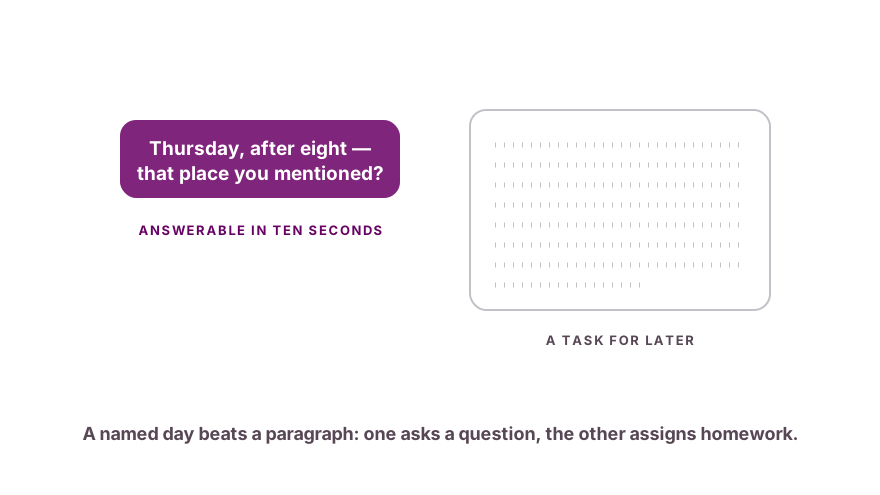
A concrete plan is an invitation with a named day attached, and it beats an open invitation every time. An open invitation transfers the work of scheduling to the person with the least room to do it. “Are you free Thursday the 27th?” is a question she can answer while standing up. “We should do something soon” is a task she has to think about later, and later is when the day gets away.
Low-cost warmth. Short, unprompted, asking nothing, such as a photo of something that reminded you of a conversation, or one line about how a thing she mentioned went. The defining quality is that it does not need a reply to have been worth sending. A message with no obligation attached is an easy one to receive.
Plain interest. Saying you like her, in words, once, without decoration. The version that lands is confident and finished — “I like talking to you, I’d like to see you again” — rather than the version that hangs there waiting for reassurance.
What lands wrong, and why?
Lines land wrong when they praise the role instead of the person, or when they hand her work to do. Six of them come up again and again.
“You’re so strong.” It is meant as a compliment and received as a description of hardship. It also makes the conversation about endurance at the exact moment she was having a normal evening. There is nothing to reply to except “thanks, I guess”.
“I don’t know how you do it all.” The honest content of this line is that her life looks difficult from outside. It invites her to explain her logistics to you, which is the opposite of time off.
“I don’t mind that you have kids.” Presented as generosity, it announces that a reservation existed and was overcome. Reservations are real and measured. The Pew Research Center reported in 2020 that 36% of single adults who were looking for a relationship said they probably or definitely would not consider a relationship with someone raising children from another relationship. That 2019 survey covers people raising children from another relationship, mothers and fathers alike, and it does not say who held the reservation or why. Which is the point — the number describes daters in general, not her, and saying it out loud in a text thread only tells her you were weighing.
“Your kid is lucky to have you.” Fine much later, strange in the first weeks. Early on it signals that you have already cast yourself in a family scene she has not invited you into.
Anything about meeting the child. Not a compliment, not a joke, not “I’d love to meet the little one someday”. The order of that decision protects a child and belongs to her, on her timing — we keep the whole subject on the parent side of the site, in introducing your kids.
The midnight essay. Four paragraphs of feeling sent at 1am asks for a matching reply from someone who will be up early. It is not too much emotion. It is too much homework.
Symmetry: the messages that land wrong from her side
The same page owes the other list, and it is the same length. Texting only in bursts and then vanishing for days without saying “I’m off-grid this weekend” reads as disinterest even when it is a school holiday. Cancelling without offering a replacement day does the same. Testing him with hints instead of asking directly whether he is seeing other people. Long stretches of conversation about the child’s week early on, when he has no role in it and no way to respond. Apologising repeatedly for the schedule, which turns every exchange into reassurance work. And using texts as an interview about intentions before the second date, which pushes people out faster than any of the above. Both lists have six items on purpose.
Does timing matter more than wording?
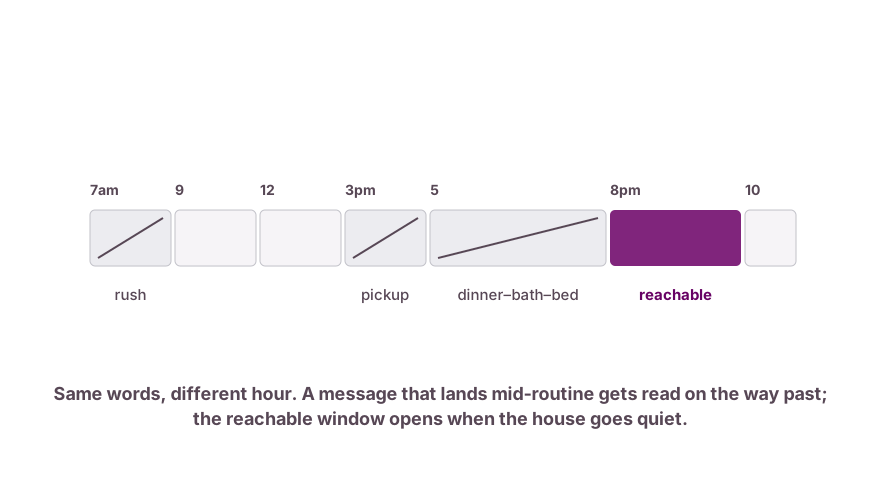
An average message at a good moment outperforms a perfect message at a bad one. Which moment is good depends on her household rather than on a rule: there is no survey of the best hour to text a parent, and the routine that swallows one family’s phone is another family’s quiet stretch. A message that lands mid-routine gets read on the way past and answered never, so the useful thing to notice is when her replies are long and when they are one word.
Imagine the same four words sent twice: once at half past five, once at nine. The first arrives in the middle of something and is gone; the second arrives when the house is quiet and gets a real answer. Nothing about the wording changed.
The stress is documented, if not the hour. The U.S. Surgeon General’s 2024 advisory Parents Under Pressure reported that in 2023, 33% of parents reported high levels of stress in the past month, compared with 20% of other adults. That figure describes parents in general and not single parents specifically — we keep the sourcing and the exact wording limits on our statistics page. It is not a reason to text less. It is a reason to send things that can be answered with one hand.
Two consequences worth taking seriously. A slow reply is information about her afternoon, not about you, and the correct response is nothing at all. And the follow-up that reads worst is the one that comments on the silence: “guess you’re busy” or “did I say something”. That message asks her to manage your reaction on top of everything else, and it is a reliable way to end an otherwise fine week.
How do you flirt when replies are slow?
Flirt in messages that survive a gap of several hours. The content is unremarkable; the rhythm is what changes. Anything that depends on rapid back-and-forth — escalating banter, a bit that needs three replies to pay off — dies overnight and reads as awkward in the morning.
What holds up is the self-contained line. A self-contained line is a message that is warm, or funny, or direct, and complete without a reply. She reads it at a red light, smiles, replies hours later, and nothing was lost.
Keep it in the adult register. Flirtation that keeps borrowing from her domestic life is not flirtation, it is commentary. And she does not need her competence admired late at night; she needs to be talked to like someone who used to stay out late and might again.
One thing to skip entirely: the joke about her having a lot on her plate. It is never new to her.
How can you tell if she’s interested?
Interest shows up in planning rather than in reply speed. Message frequency is a weak signal, and fast replies mean a phone was nearby. Effort means the concrete things a person spends to see you, and it has a specific shape here:
- She offers an alternative day when something moves, rather than leaving the plan floating.
- She tells you in advance about a stretch when she will be unreachable, which is how adults with schedules say “I’m still here”.
- She arranges an evening, which costs her something concrete, for example childcare or a favour owed to a neighbour.
- She asks questions about your week that have nothing to do with logistics.
- She starts conversations, not only answers them.
The inverse mistakes get their own page, since some of them are misread schedules rather than signals: red flags and green flags, both ways.
The one-line version
Write to the person, plan on named days, keep it short enough to answer standing up, and let silence be silence. Everything else on the practical side — lead time, money, which questions are worth asking early — sits on the advice page.
No wording rescues a mismatch, and none is needed when there isn’t one. The point of getting the messages right is only to stop losing weeks to problems that were about scheduling.