
Dating single mom advice is guidance about one constraint in particular: a partner whose week is set by custody, school and childcare rather than by mood. Most of it online stops at “be patient” and “don’t be late”, which is advice for dating anyone. The parts that are actually specific are duller and more useful: how far ahead plans get made, which questions are worth asking early, and where money enters the conversation sooner than you are used to. The rest of what changes day to day sits on the hub.
One framing note, since both sides of this read the same page. Nothing below is a verdict about a person. It is a description of how a relationship works when one person’s week is set by someone else’s schedule.
How far ahead should you plan a date?
Further ahead than feels natural: name a specific evening one or two weeks before the week it falls in. Lead time is the gap between proposing an evening and the evening itself, and it is the single biggest behavioural change here. A date that works is one proposed on a named evening, at a named place, well before the week it falls in. A date that dies is “want to grab something tonight?”
That is not about eagerness. Childcare has to be arranged, or the evening has to fall inside a period when the child is with the other parent. Both of those are decided ahead of time and neither is decided by her alone.
Two practical consequences. First, ask which evenings are workable over the coming weeks rather than proposing one and waiting to be told no. Second, when something moves, offer the next concrete slot in the same message. An evening that gets rescheduled with a replacement attached reads as interest; one that gets rescheduled into “sometime soon” reads as an exit.
Expect cancellations that have nothing to do with you. For example, a child with a temperature ends the evening regardless of how well it was going. The useful response is short and boring: fine, are you free Thursday instead.
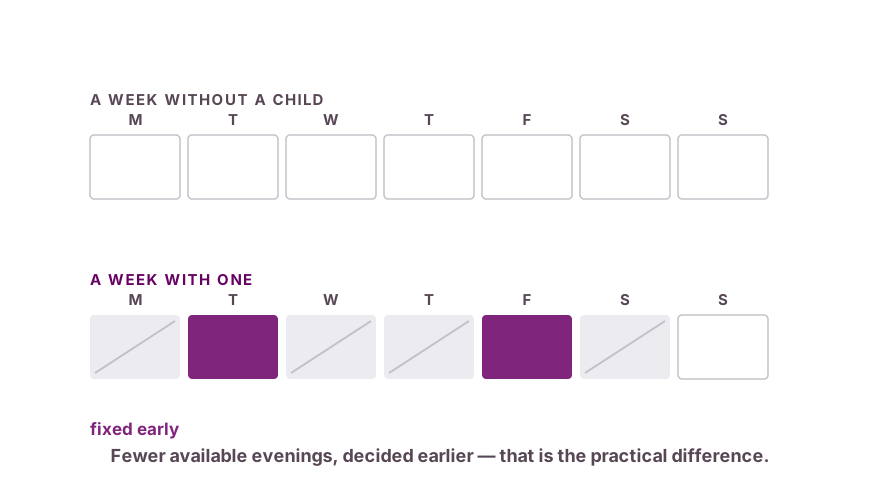
What should you ask about early, the schedule or the ex?
Ask about the schedule and leave the ex alone. A custody arrangement is the agreed pattern of which nights a child spends with each parent, and it is the part that decides whether an evening exists at all. “What’s the custody arrangement like?” is logistics. “So what happened with her dad?” is an interview about a relationship you were not in.
Ask the first. It tells you which weeks look different from each other, whether the pattern is weekly or fortnightly, and how much of it is fixed. That is everything you need to make plans, and it does not ask her to narrate an old relationship on a second date.
The other reason to keep off that ground: the assumption underneath it is often wrong. Among mothers maintaining one-parent family groups in 2022, the U.S. Census Bureau reported that 51% had never married and 29% were divorced. Not every single mother has a divorce behind her, and the split does not tell you anything about any individual. It is a correction to a default assumption, and then we stop — the sources are laid out on our statistics page.
If the past comes up, she will bring it. Custody arrangements, support and legal questions are a solicitor’s territory, not ours and not a second date’s.
Why do money conversations happen earlier here?
Because the evening is paid for before it happens. Childcare cover is the arrangement that makes an evening out possible: a sitter, a grandparent, or a night the child is with the other parent. What surfaces early is not the amounts. It is the shape.
In a relationship without children, who pays for what can stay vague for a long time. Here it surfaces early, because the cost of an evening out includes childcare that exists whether or not the date goes well. An evening that is expensive before either of you leaves the house changes what “let’s just see” costs.
What helps: propose plans with the price visible in the proposal. For instance, “dinner at the place on the corner” and “a walk and coffee” are different offers, and letting her know which one you mean lets her decide what to arrange. Alternating who pays is fine. Assuming she will split everything because “she’s independent” is a decision you made for her.
What does not help: paying for things and mentioning it later, or treating a cheaper suggestion from her as a hint about how the evening is going. Sometimes it is a hint about the week.
What does she probably not say out loud?
Three things, and the first is that some of this has happened before. In a survey of single adults looking for a relationship, conducted in 2019, the Pew Research Center found that 36% said they probably or definitely would not consider a relationship with someone raising children from another relationship. The survey does not say who those daters were or why, and it does not measure anything about mothers specifically. What it does establish is that the reservation is real and measured, and not something anyone here invented.
Also unsaid, usually: that she is deciding how much of the schedule to hand over. Telling you which evenings are free is a small amount of information about a child’s life going to someone she barely knows yet. Slow disclosure there is not distance. It is the same care you would want from anyone raising a child.
And this one: she is watching whether the interest survives an inconvenient week. Anyone can be pleasant when a plan works. The flags in both directions are about what happens when one doesn’t.
What he probably won’t say either
That he is not sure what he is signing up for, and that asking feels like admitting he might leave. That the pace can feel like being kept at arm’s length, and he cannot tell whether it is caution or a lack of interest. That he does not know whether to offer help with the practical side or whether offering would be presumptuous.
Also this: that he is aware he is being assessed and has no idea against what. That is uncomfortable in the ordinary way, and saying it out loud usually costs less than carrying it.
Both lists are short for the same reason. The things people do not say are the things that later get described as “it just stopped working”.
What is different if she’s in her twenties?
Less than the separate category suggests: the adjustments are the ones above. Two things do differ in practice.
Her support arrangements may lean on family, such as a grandparent or a sibling, rather than on a formal schedule, which means an evening can depend on a third person’s plans. And app use is more common in that age band generally: the Pew Research Center reported in 2023 that 53% of U.S. adults under 30 have ever used a dating site or app, compared with 37% of those ages 30 to 49. That measure covers all adults by age, not mothers, and it is about ever using an app rather than using one now.
There is also an age gap dynamic worth naming plainly: a woman in her early twenties raising a child gets approached by men who read the situation as an opportunity rather than a relationship. She knows that. Being unhurried and specific is how you read as neither.
The variable that moves more than her age is the child’s, which is why we put that on its own page.
The one-line version
- Plan earlier, and name the evening before the week it falls in.
- Ask about logistics rather than history.
- Be clear about money before it becomes a subtext.
- Let the pace be set by whoever needs it slower.
If you want the wording side of this — what lands and what quietly does not — that is a separate page.
None of that guarantees anything. It just removes the failures that were about scheduling and left the ones that are about whether two people suit each other, which is the only interesting kind.