
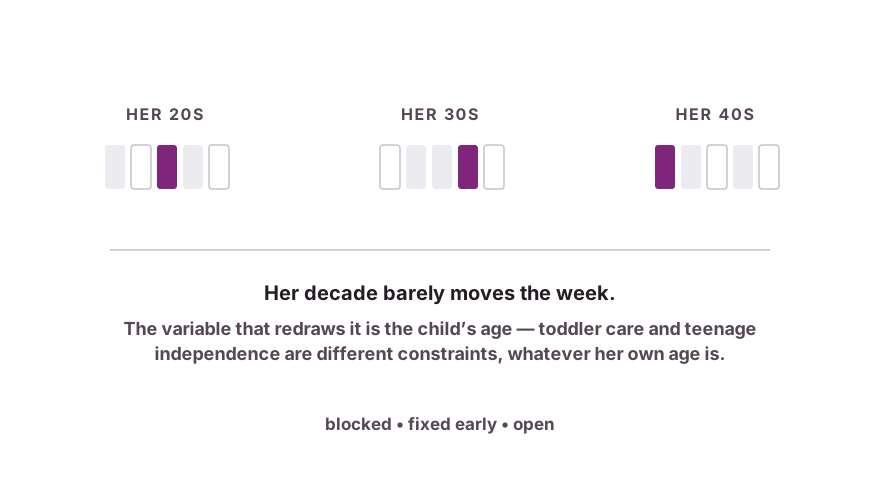
People search for dating a single mom in her 40s, then for her 20s, then for her 30s, as if each decade were a different activity. It mostly isn’t. Across those three searches the practical differences are small, and the thing that actually reorganises a relationship sits in a different column entirely: how old her child is.
Dating a single mom in her 40s is a phrase about her age rather than about her week, and the week is the thing a relationship has to fit into. A two-year-old and a fourteen-year-old produce two completely different weeks. A thirty-one-year-old and a forty-three-year-old, with children the same age, produce much the same one. That is the whole argument of this page, and the rest of it is detail. What changes day to day, regardless of age, is on the hub.
One framing note, because both sides of this read the same page. Nothing below rates anyone by decade, and nothing below is a measured breakdown by decade — no survey we would cite publishes one. It describes what tends to be true about schedules, and where the assumptions people bring turn out to be wrong.
What is dating a single mom in her 20s like?
It usually means a young child and informally arranged cover, so a free evening depends on somebody else’s week as well as on hers. The recurring feature here is not the child. It is who else is involved in making an evening possible.
Informal childcare is cover provided by a relative, friend or neighbour rather than by a paid or contracted arrangement, and it is the common shape of support at this stage. Support often comes from family: a parent, a sibling, someone who lives nearby. That means a free Thursday can depend on a third person’s plans rather than on a fixed arrangement, and it can evaporate for reasons nobody could have predicted on Monday. For example, an evening that rested on a grandparent’s day off disappears when the day off moves. The useful response is the same as always: offer the next concrete slot rather than “sometime soon”.
Meeting may well have started on an app, though not for any reason to do with motherhood. App use is higher among younger adults generally: the Pew Research Center reported in 2023 that 53% of U.S. adults under 30 have ever used a dating site or app, compared with 37% of those ages 30 to 49. That figure describes adults by their own age, says nothing about parents, and measures ever having used an app rather than using one now. The sources are set out on our statistics page.
There is one dynamic worth naming plainly, and it belongs to this section rather than the others. A woman in her early twenties raising a child is approached by people who read the situation as an opportunity rather than as a relationship. She knows that. Being unhurried, specific and uninterested in her circumstances as leverage is how you read as neither.
The mirror of that, on his side: a man in his twenties dating a mother can be the one being asked, by his own friends, why he would. That question deserves no more answer than any other question about someone else’s relationship, but it is worth knowing it will be asked, because it is where a lot of quiet pressure comes from.
What changes when she is in her thirties?
The schedule usually stops being the problem, and the pressure moves to everything competing for the same evening. This is the decade where the arrangement tends to be formal and stable. Where the custody pattern is settled, childcare is a known cost, and the schedule looks the same most weeks, plans made ten days out tend to hold.
A custody arrangement is the schedule that fixes which nights a child spends with which parent. It is set outside the relationship, by the two parents or by a court, and neither of you can trade a night in it to suit a dinner.
What tightens instead is everything around the schedule. Careers can be at their most demanding here on both sides, and the free evening that survives work is the same evening that has to survive childcare. Fewer, longer, better-planned dates is not a preference at this stage. It is arithmetic.
The other thing that differs: the pace of the relationship can be slower than either person expects, and for a reason neither of you chose. Two adults with fixed weeks accumulate hours together more slowly than two adults with open ones, so the point at which you know each other properly arrives later on the calendar than it would have at twenty-five. That is not a signal about interest. Reading it as one is a common and expensive mistake, and it sits alongside the other misreadings on our page about flags in both directions.
What should you expect dating a single mom in her 40s?
Expect fewer childcare gates, more directness about what the relationship is, and an older child whose opinion carries weight. Two assumptions also arrive with this decade, and both are worth checking.
The first is that a single mother in her forties is divorced. Not by default. Among mothers maintaining one-parent family groups in 2022, the U.S. Census Bureau reported that 51% had never married and 29% were divorced — a figure covering single mothers of every age, not this decade specifically. That corrects an assumption and nothing more: it says nothing about any individual, and how a past relationship began or ended is hers to raise or not. Custody and support questions belong with a family lawyer, not with a second date. The figure and its exact wording are on our statistics page.
The second assumption is that an older child means an easier relationship. Some of it is easier. Childcare stops being the gate on every evening, the logistics of a night out shrink, and there is less improvisation. Imagine a Saturday that needs no sitter booked: the evening is simpler to arrange, and a fifteen-year-old still has a view about who is in the kitchen when you get back. But an older child is a person with a view, a social life of their own, and years of watching how adults come and go. Nothing about that is smoother. It is differently demanding, later on, and it is the reason introductions in this decade are slower rather than faster.
What can be genuinely different at forty is clarity. Plenty of people at this stage know what they are looking for, say it earlier, and lose patience faster with vagueness. If you are used to several weeks of ambiguity being normal, expect the question of what this is to arrive sooner than you are used to.
And symmetrically: she may well have been through a version of this before, including the part where someone withdrew once the schedule became real. That history is why an inconvenient week is worth more as evidence than a good first date.
Why does the child’s age matter more than hers?
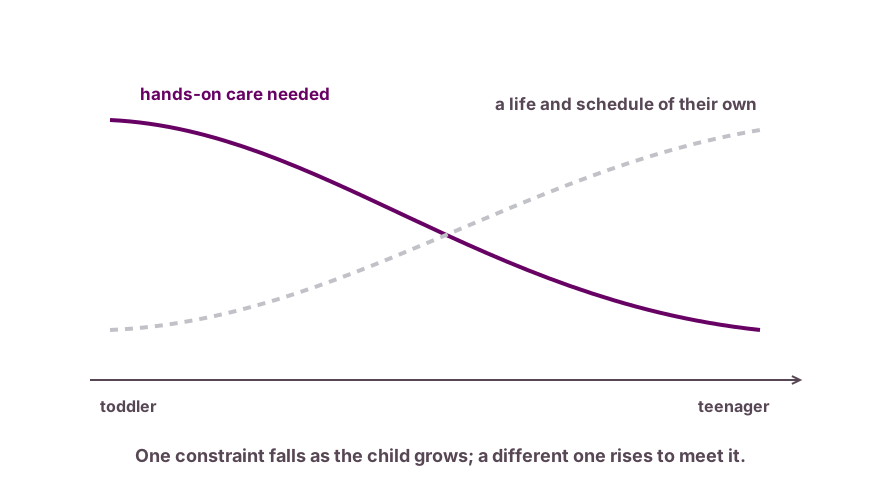
The child’s age decides how an evening has to be produced, and her decade only sets the context around it. Consider two women a decade apart with children the same age: their weeks look alike. Take one woman and move her child from three to thirteen, and almost everything about dating her changes.
Lead time is the gap between proposing a plan and the evening it happens on, and it is the measure that stretches furthest when the child is small.
- A small child. Every evening out requires arranged cover, so plans get made further ahead and moved more often. Illness ends an evening with no notice and no appeal. Time together happens almost entirely away from home. Nothing about the child appears in the relationship for a long while, and that is by design rather than by secrecy.
- A school-age child. The schedule becomes legible: term time, fixed weeks, activities that repeat. Evenings are still gated, but the gate is predictable. This is the stage where plans survive best and where the practical advice on planning further out pays off most obviously.
- A teenager. Childcare largely stops being the constraint and is replaced by something less mechanical. A teenager notices, forms views, and may have strong feelings about a parent dating at all. Evenings free up; the relationship’s exposure to a third person’s opinion goes up. Anything to do with meeting that child is a separate decision on a separate timeline, and it is not sped up by the child being old enough to “handle it”.
Two things stay constant across all three. The introduction is never a way of testing whether the relationship works, and none of the above is a reason to be curious about the child before she raises the subject. Where that line sits is its own page, written from her side.
What doesn’t change with either age?
Everything that actually governs the week is the same at twenty-six as at forty-four. Worth stating, because the age-specific pages online tend to invent differences that are not there.
The lead time on plans. The fact that a cancellation can be a childcare failure and not a verdict. That asking about the schedule is useful and asking about the ex is an interview. That money enters the conversation earlier, because an evening out has a cost before either of you leaves the house. That the pace is set by whoever needs it slower.
Also unchanged: what she is weighing. Whether the interest survives an inconvenient week, whether you are consistent when it costs you something, and how much of her child’s routine it is reasonable to hand to someone she has known a few weeks. None of that is a function of her being twenty-six or forty-four.
Which app works best at which age?
No app is better at a particular age, and there is no verified data on the age composition of any dating app’s users that we would print. The numbers circulating on that question come from the companies themselves. What we can say is which services are built around parenthood being stated up front rather than disclosed later, and that distinction matters more than a decade label. That comparison lives on our apps page, with check dates attached.
The measured thing about age and apps is the one already cited above: adults under 30 report ever having used one at a higher rate than adults ages 30 to 49, per the Pew Research Center in 2023. It is about adults, not mothers, and it is not a recommendation.
The short version
If you searched for a decade, you were probably looking for the child’s age. In her twenties expect family-shaped support and evenings that depend on other people. In her thirties expect a settled schedule and a slower accumulation of hours. In her forties expect fewer childcare gates, more directness, and an older child whose opinion counts.
Then ignore the decade and ask which age the child is, because that is the number that decides what your week together looks like.