
The pros and cons of dating a single mom are a description of an arrangement rather than a verdict on a person. The arrangement: a schedule set outside the relationship, plans that move, a slower pace, and a child who is not a detail. The search that brings people here is some version of “is this a bad idea”. Read as intended, that question asks for a verdict on a person, and a verdict on a person is not something anyone can hand you. What can be described is the arrangement: what changes in your week, what turns out to be noise, and what the other side is taking on at the same time.
If you want the wider picture of how this differs from dating someone without children, the men’s hub covers what changes day to day. This page is narrower: the trade-offs, in both directions.
What do people actually find hard?
The schedule is not negotiable between the two of you. Her free evenings are produced by an arrangement made before you existed. You can ask when she is free. You cannot trade for a Friday. It is easy to read that as being deprioritised — a fixed constraint mistaken for a signal about how she feels.
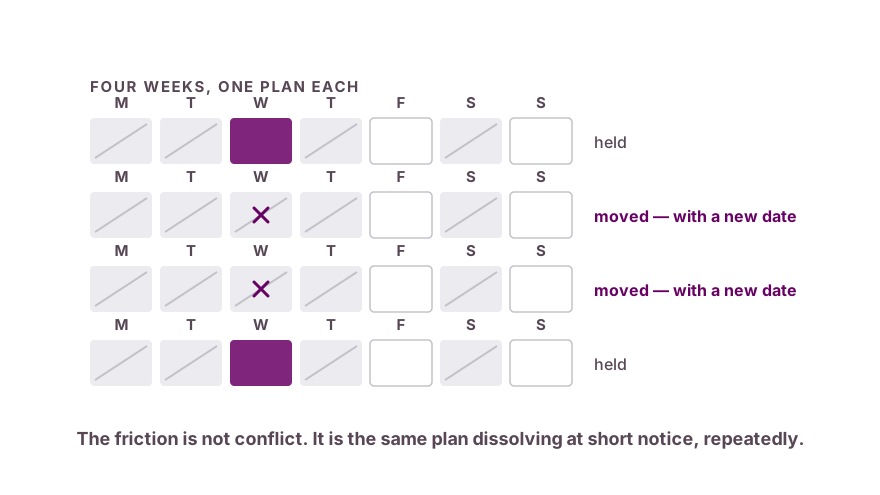
Plans move, sometimes at short notice. The causes are ordinary, such as a fever, a sitter who cancels, or a handover that slips. A handover is the moment a child passes from one parent to the other, arranged in advance and easy to disrupt. The cancellation is not an opinion of you. It comes from a source that does not exist in a relationship without a child in it, and the adjustment it demands is that you stop treating each date as a statement of interest.
The pace runs on a different clock. Meeting the child is a separate stage that comes later, and it does not arrive because things are going well or because you have earned it. If you expect access to the whole household on a normal relationship timeline, this is the part that will not bend.
Money enters the conversation earlier. Not as a demand: as logistics. An evening out has a childcare cost attached to it, so “let’s just see” is an expensive sentence here. That means practical money talk arrives earlier here than it otherwise would.
And there is a third person in the relationship who did not choose you and owes you nothing. That is a structural fact, not a difficulty to be solved by being good with kids.
You will be asked about it by people who are not in it. Friends who want to know when you are “meeting the kid”, for instance, or relatives who treat the relationship as a decision with a right answer. The commentary arrives early, and it asks you to justify something you have not finished deciding.
One reframe changes how the friction above reads: you are not competing with a child for priority. A parent’s obligation to a child is not the same currency as interest in a partner, and reading a cancelled evening as a ranking is how people end up angry about a fever.
What did people expect to be hard, and wasn’t?
The ex, as a permanent character. What this looks like in practice is administration: dates, handovers, a text about a school form. Our advice page makes the practical version of this a rule — ask about the schedule, not about the ex. What her past relationship was and how it ended is not our subject and, more usefully, is not yours to audit.
The assumption that she is divorced and recovering from it. The U.S. Census Bureau reported that among mothers maintaining one-parent family groups in 2022, 51% had never married and 29% were divorced. That is marital history and nothing more: it tells you the default assumption is not reliable, and it tells you nothing about any individual. We keep the full set on our statistics page with the wording each figure allows.
Being the outsider forever. The role has no name for a long stretch, which is uncomfortable rather than unbearable. It is also temporary in one direction only: it ends by the relationship becoming serious, not by you pushing for a title.
Having to become a father overnight. Nobody hands you the role on a schedule, and stepping into decisions about a child you barely know is a mistake rather than a requirement. The practical version is smaller and duller: be consistent about the plans you agreed to.
The child disliking you on sight. Since the introduction happens late and briefly, the dread attached to it is spent on an event that has not been scheduled. That is a good use of the waiting time, if it stops you asking for the meeting sooner.
What is she taking on by dating you?
A different set of risks, and the list is not shorter than yours. The section above is one half of the page; here is the other half.
She is deciding whether an unknown adult gets closer to her household. That decision has a different cost profile than yours. If you are wrong about her, the cost is yours alone; if she is wrong about you, it is not. Risk asymmetry is that gap between what each side stands to lose, and it is the whole reason her caution reads as slowness.
Every hour with you is drawn from a fixed pool. Not a metaphor: the hours exist or they do not, and one spent on a first date that goes nowhere is not recoverable. That is why vagueness costs her more than it costs you.
Every evening out is paid for before it starts. Childcare is arranged and covered whether the date goes well or not. That is the mirror of the money paragraph above: the cost of finding out is not split evenly.
She is explaining the same things again. The schedule, the boundary around her child, why she cannot decide tonight. Being asked to justify it again from the start is its own kind of work.
She is risking her child’s routine. Not the introduction alone. A partner who becomes part of the week and then leaves changes something a child noticed, and she carries the aftermath alone.
She is being assessed as a category. Search results about her situation are written to help someone decide whether she is a good bet. She reads them too.
What you take on
- A schedule you cannot negotiate and did not set
- Plans that move at short notice, repeatedly
- A slower pace, with the introduction as a separate later stage
- Money and logistics discussed earlier than usual
- A long stretch in a role that has no name yet
- Questions from friends and relatives who are not in it
What she takes on
- Deciding whether an unknown adult comes closer to her household
- Spending hours from a fixed pool on someone unproven
- Explaining the same constraints again from the start
- Risking a change to her child's routine if it ends
- Being read as a category rather than a person
- Paying for childcare before an evening has proved anything
If you have never had a child in your life, the adjustment is specific enough to have its own page: dating a single mother when you don’t have kids.
What does the internet say about this, and what holds up?
Mostly forum threads, and they hold up as a list of failure modes rather than as evidence. They are worth reading as recurring stories, and they cluster into three shapes.
- “She only wanted a babysitter or a wallet.” It is a recurring story, and what sits inside it is a relationship where nobody said out loud what they were doing there. Nothing about it is specific to parenthood, and the same story gets told from her side about him.
- “I regret it, I got attached to the kid.” This one holds up as a real risk, and it is the argument for the late introduction rather than against the relationship. Attachment that forms before the adults are stable is the cost the order of steps exists to avoid.
- “Horror stories.” A forum collects endings, not relationships. What you cannot learn from it is how often anything happens, which is why we will not put a share on it.
The pattern across all three: the threads are written at the end, by whoever had the worse night. Survivorship bias is the name for the rest of it — a relationship that simply worked produces no post, so the record you are reading is made of endings. Read them for the failure modes they name — unspoken expectations, an introduction that came too early, an exit that dragged — and not for how likely anything is.

One measured number sits near this question and is routinely stretched past what it says. Pew Research Center found in a 2019 survey that 36% of single adults looking for a relationship said they probably or definitely would not consider a relationship with someone who is raising children from another relationship. It is not split by gender, it does not name mothers, and the remaining share is not a measured willingness to date anyone. So the honest answer to “what share of men would date a single mom” is that nobody has measured it.
For scale rather than sentiment: the U.S. Census Bureau’s Current Population Survey counted 9.8 million one-parent households in the United States in 2023. Households, not people, and not a count of anyone who is dating.
Behaviour beats category
If you are trying to work out whether a particular relationship is a bad idea, the useful signals are behavioural, and they exist on both sides. Pressure to meet the child early is one. Contempt about a schedule that was explained in advance is another. Our red flags page lists them in both directions, with the same number of items on each side, because the second list is the one that rarely gets written.
What is not a signal: being a parent. That is a circumstance, and circumstances do not predict behaviour.
What if you’ve decided it isn’t for you?
That is a legitimate answer, and it does not require a justification, a theory about single mothers, or a bad ending. Two things make it clean.
Say it early and plainly. Not by fading out. She is allocating hours she cannot get back, so a clear no is worth more here than almost anywhere else.
Say it before you meet the child. Imagine a meeting has already been floated and you are still unsure: the exit belongs before that meeting, not after it. This is the one point on this page with no nuance attached.
Two versions of this regret recur under the search “I regret dating a single mother”: an exit that was delayed, and an attachment that formed earlier than the relationship could support. Both are about sequence, and both are avoidable in advance rather than resolvable afterwards.
Deciding the conditions do not suit you is not a verdict on anyone. It is the same decision as turning down a job in a city you do not want to live in — accurate about you, and silent about everyone else.
What we can’t help with
Custody, child support, and anything with a legal shape belong to a family law professional in your state, not to an article. If a relationship question turns into a legal one, that is the point where this site stops being useful.