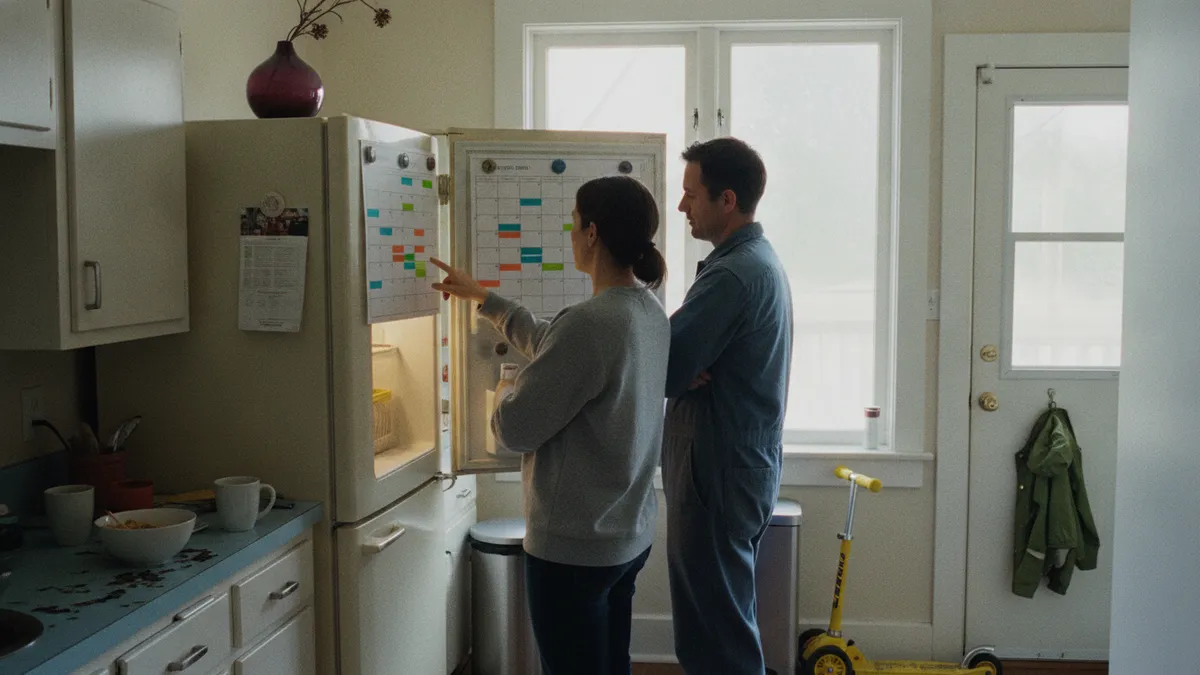
Single dad dating single mom is the case where both partners are already parents, so the relationship carries two external schedules rather than one. It is not a simpler version of the same relationship. Hers is produced by one custody arrangement; yours by another; neither was designed with the other in mind, and the two of them shape what your calendar looks like for the next year.
The men’s hub covers what changes when one of you is a parent. This page is about the version where both of you are, which is a different problem: less explaining, more arithmetic.
Why do two custody schedules rarely produce the same free week?
They were written separately, by two different households, with no reference to each other and no reason to align. A custody schedule is the arrangement fixing which nights a child is with which parent, and neither of you can trade a night out of the other’s.
Start with the mechanics, because everything on this page comes out of them. Each of you has a set of evenings that are already spoken for and a set that are not. The evenings that are free for both of you at the same time are the intersection of two arrangements that were never coordinated. Three shapes recur:
- If your weeks with your children run opposite hers, the overlap can be generous.
- If they run in parallel, you get the same free windows and can plan into them.
- If they run on different cycles altogether — such as one alternating, one fixed to weekdays and one shifting with a work roster — the intersection is thin and irregular, and no amount of goodwill widens it.
The practical move is unglamorous: compare calendars early, out loud, before either of you starts proposing dates. Not as a commitment, as a survey. Which weeks are yours, which evenings are fixed, how much notice a change normally gets. Doing it early is what stops a fixed constraint being read as a lack of interest later.
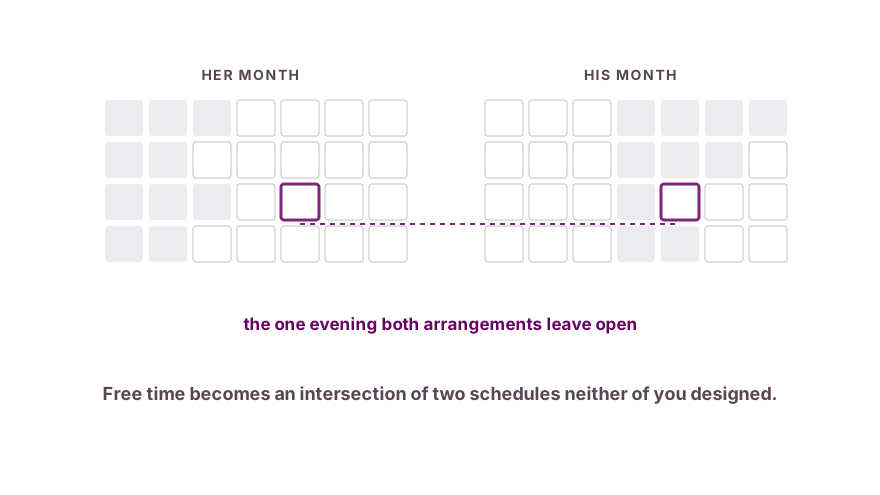
The second move is planning further out than feels natural. When a mutual free evening appears three weeks ahead, it is worth booking three weeks ahead. Spontaneity is not banned here, it is just expensive: it depends on two sets of childcare going right on the same night.
And there is a version of this that quietly damages things. Treating a rare shared evening as a test — of chemistry, of effort, of whether this is working — loads more onto one dinner than one dinner can carry. The evening is scarce because of two custody arrangements, not because anyone is holding back.
What gets easier when both of you are parents?
The explaining stops. Neither of you has to translate a cancelled evening, and neither of you has to argue for a slow pace. Here is what improves, and it is not small.
Imagine a call at six o’clock on the night itself. When she cancels because a child is running a fever, you already know what that evening looks like on her end, and you do not spend the night deciding what it meant. When you cancel for the same reason, you get the same treatment. In a relationship where only one person has a child, the cancellation is a recurring negotiation. Between two parents it is Tuesday.
The same goes for the pace. Both of you know that meeting a child is a separate stage that arrives later, on its own terms, and is not a reward for a relationship going well. Nobody has to be persuaded of that, which removes a friction that runs through the other pages of this hub. Where one of you has no children of their own, the adjustment is real and worth reading about on its own — that is what dating a single mother without kids of your own covers.
Money conversations also arrive with less charge. An evening out has a childcare cost attached for both of you, which makes it a shared logistics problem rather than one person’s inconvenience. Symmetry does that: whatever you are asking her to arrange, you are arranging too.
Where does it get harder instead?
It gets harder wherever the children are involved. The shared understanding between the two of you is real, and it does not carry into those parts.
Two sets of children owe each other nothing. For example, nothing you and she agree between you obliges a nine-year-old to like a twelve-year-old. Any plan that depends on the children getting along is a plan resting on people who did not agree to it, and the expectation itself is a weight those children did not ask to carry.
There are two introduction timelines, not one. Each child is a separate decision, made by the parent whose child it is, at a moment that has nothing to do with the other household’s readiness. An introduction means the first meeting between a child and a parent’s partner, and it belongs to the parent whose child it is. She may be nowhere near introducing hers when you are considering yours, and that mismatch is a normal outcome rather than a signal about the relationship. The one rule that holds in both directions: the relationship is stable first, the introduction comes after, and it is never a way of finding out whether the relationship works.
Two sets of household rules exist and are none of your business yet. Bedtimes, screens, food, discipline: how a child is raised is the decision of that child’s parent. Comparing systems out loud early is a fast way to make a promising thing awkward. This site does not give parenting advice, and a partner offering it uninvited is on the list of things we treat as a warning sign in red flags on both sides.

Assuming you already understand each other is its own trap. Shared circumstance is not shared experience. Her arrangement, her workload and what her week costs her are specific to her, and “I know exactly what that’s like” tends to land as a way of not asking. Same in reverse: she does not automatically know what your handover weekends look like either.
Anything legal stays with a professional. Custody terms, support, what either of you is permitted to do while a partner is in the house: those questions have answers. They come from a family law practitioner in your jurisdiction, not from an article. We do not explain them here, and we would not be doing you a favour if we tried.
What do the numbers actually say?
They describe households, not couples, and none of them counts how single parents pair up. Two single parents dating each other feels like a large, obvious category, and the published data is thinner than the feeling. The U.S. Census Bureau counted 9.8 million one-parent households in the United States in 2023, of which 7.3 million were mother-only and 2.5 million were father-only. A one-parent household is a household maintained by a parent living with their own children under the age of eighteen, with no spouse present. That is why the figure is not a count of people who are dating, and why nothing in it describes who pairs up with whom.
One assumption is worth correcting before it shapes a first conversation. Among mothers maintaining one-parent family groups in 2022, the Census Bureau reported that 51% had never married and 29% were divorced. That is marital history and nothing more. It says nothing about any individual, and it is a useful reminder that “so, how long were you married?” is a question built on a guess. We have no verified equivalent figure for single fathers, so this page does not offer one.
Both figures, with their sources, publishers and the exact wording each one permits, sit on our statistics page — including the marital-history breakdown. What no source we could verify measures: how many single parents date other single parents, or how long anyone waits before dating again. Those pages on this site ship without a number on purpose.
Where do two single parents actually meet?
In the same places as everyone else, filtered by which of them can be reached after bedtime. Time is the filter, not preference. The places that require a free Friday evening select against both of you; the ones that run at 10pm after bedtime do not. That is most of why apps do the heavy lifting here, and why apps built specifically around parents exist at all.
There is no measured share to quote here either. The Pew Research Center summary of online dating in the United States, published in 2023, carries no breakdown by parental status, so nobody can tell you what proportion of single parents are on an app.
Whether a niche app beats a general one is a local question — it depends on how many people near you are on it, which no review can promise you in advance. Our apps section sets out what each one does, what we have verified and what we have not, without a ranking we cannot defend.
The short version
Two schedules, rarely the same week: plan further out, compare calendars early, and stop reading cancellations as verdicts. In exchange you get a partner who never needs the situation explained. The harder part is not the two of you at all. It is that each household arrives on its own timeline, and neither set of children asked for any of this.