
The Stir dating app is a dating service for single parents, owned by Match Group, on which parenthood is a condition of joining rather than something you disclose three conversations in. That single decision is the whole product. This review says what the app is, who runs it, what the free tier stops you doing, and — deliberately — no prices, because we have not paid for it.
What is the Stir dating app?
Stir is a dating app for single parents, run by Match Group — the company behind apps such as Tinder, Hinge, Match and OkCupid. That ownership is the most useful fact about it. It explains the interface: swipe cards, mutual matches, and an upgrade prompt at the point where you want to say something. It explains the distribution through the official app stores. It also explains why any survey Stir publishes about single parents is marketing from an interested party, not research.
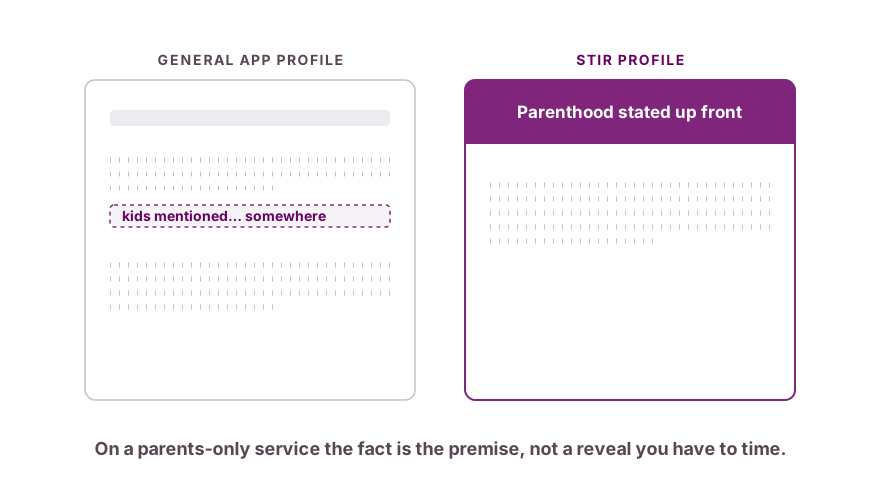
The product idea is narrow and, on its own terms, sound. On a general app, being a parent is information you have to place: too early and it reads as a warning label, too late and it reads as a withheld fact. On Stir it is the entry condition. Nobody is surprised, and nobody has to be told twice that Saturday depends on someone else’s week.
What that does not do is change the arithmetic of a small city. A niche app has a niche pool by definition. If the general apps are quiet where you live, the niche one is quieter.
How much does Stir cost?
We do not know, and we are not going to pretend otherwise.
A verified price is one read off a real purchase screen, after registering an account with real payment details. That has not happened here. Prices circulating in review listings for this app trace back to other listings rather than to a purchase screen, and copying one would make this page look more informative while making it less true.
Affiliate disclosure, before the table rather than in the footer: some links in this section of the site can earn us a commission. Nothing on this page is arranged by commission, and we have no commercial relationship with Stir or Match Group. The absence of a price below costs us money and is the correct call anyway.
| Question | Status | What that means for you |
|---|---|---|
| Who owns it | Verified | Match Group — same operator as Tinder, Hinge, Match |
| Who it is built for | Verified | Single parents; parenthood is stated, not revealed |
| Download and browse | Free tier | Profile creation and looking around cost nothing |
| Subscription price | Not verified | Requires a real registration with payment details; see the app's own purchase screen |
| Exact free-tier limits | Not verified | Limits can vary by region and account age; the app's own upgrade prompt is the current answer |
| Success rates | No source exists | Every figure of that shape comes from a platform's own marketing |
If pricing matters more than the app itself, the more honest comparison is what each app blocks rather than what each app charges — that is the subject of where the free tier stops being free.
What does the Stir free tier actually let you do?
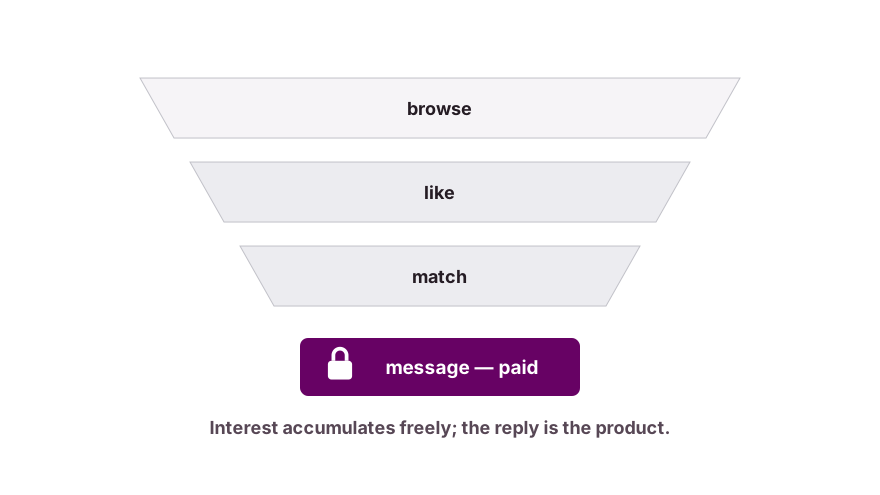
It lets you install the app, build a profile, browse and swipe, and it stops where a match would become a conversation. A free tier is the set of actions a service allows without a subscription, and the pattern across Match Group apps is consistent enough to describe without inventing numbers. The free account is generous with everything that fills the app and tight with everything that resolves it. The wall arrives where you want to send a first message, or to know who already liked you.
That shape is worth naming plainly, because it is how the category works on you: the free tier is designed to accumulate a queue of unanswered interest, then sell you the key. Knowing that in advance is not cynicism, it is just reading the business model before it reads you.
Consider the ordinary sequence. You install the app on a Tuesday evening, write a profile, browse for a while and collect a handful of matches. Nothing has cost anything so far. The first thing you actually want to do with those matches is the thing the subscription opens.
Two practical notes. Limits inside these apps can vary by region and account age, so someone else’s screenshot is not evidence about your account. And before paying anything, find the cancellation path — it lives in your app-store subscriptions, not inside the dating app — so the decision to stop is as easy as the decision to start.
Who does Stir suit, and who does it not?
It suits you if you want the fact of a child stated in the premise, and if the app scene where you live is busy enough for a subset of it to still be a scene.
It suits you less if you are in a thin market, or if you are hoping a niche audience means a kinder one. The audience is smaller, not different in character. A well-written profile is worth more than the app you write it on — that is the argument of our guide to writing a dating profile as a parent, and it applies identically on Stir.
Member density is the number of active accounts inside a distance you would actually travel, and on a niche app it decides everything else. No review can measure it for your postcode. The check that works is the free one: install, browse, and count how many recent profiles appear inside that distance.
Some context on expectations. Pew Research Center, in a survey of U.S. adults fielded in July 2022, found that three-in-ten U.S. adults say they have ever used a dating site or app. That figure covers all adults, married ones included, and measures “ever used” rather than current use. It is not broken out by parenthood; no such breakdown exists, which is why this site does not publish one. It sits with its source on our statistics page.
What works
- Parenthood is the premise, so the schedule conversation starts from a shared assumption
- Run by a named, established operator with official app-store distribution
- Familiar interface: no learning cost if you have used a mainstream app
- Free to install, build a profile and browse before deciding anything
What doesn’t
- A niche pool is a smaller pool; density near you decides the whole experience
- Messaging sits behind the paywall, so the free tier is a look, not a service
- Limits and prices can vary by region, so no review can pin them for your account
- Being a parent as an entry condition does not filter for anything else you care about
How do you sign in or fix an account problem?
You do it in the app itself, or in the store account you installed it with. We do not host a sign-in form and never will. A phishing page is a copy of a real service’s login screen built to collect the password typed into it. A review site reproducing an app’s sign-in form is either running one or one step from being mistaken for one.
Three things are worth checking before anything else. If you signed up with a phone number or a social account, for example, use that same route again rather than creating a second profile. If a password reset does not arrive, check the address tied to the account rather than the one you use now. If billing is the problem, it is handled by Apple or Google, not by the app’s support desk, because that is where the subscription is stored.
If you cannot get in and support is slow, do not solve it by making a new account with the same photos. Duplicate profiles get flagged, and you will end up arguing about two accounts instead of one.
What we don't do on review pages
This page is thinner in one specific way than the pages competing with it, and that is deliberate.
- We don't print prices we haven't paid
- Verifying a subscription means a real registration with real card details. Until we do that, the price line stays empty rather than copied from an aggregator.
- We don't invent hands-on experience
- There is no long-term testing section here, because we have not run one. What we describe is ownership, product design and the category's paywall pattern.
- We don't reproduce anyone's interface
- No screenshots of a service we have no rights to, no imitation login screens, no page styled to look like the app's own.
- We don't score apps out of ten
- A score implies a methodology. Ours would be one editor's impression with a decimal point on it.
What is actually checked here
- Ownership
- Stir is a Match Group product. Stated in the first section because it explains the interface, the distribution and the marketing.
- Dates
- Every claim on this page carries the date it was checked: 20 August 2026. If it is not re-checked, the date will show that.
- Numbers
- The only two figures here come from Pew Research Center and are named in the same sentence as the publisher and the survey date.
- Independence
- We have no commercial relationship with Stir or Match Group, and nothing on this page is arranged by commission. The affiliate disclosure sits above the table, not in the footer.
What should you check before you subscribe?
Check that the subscription on offer opens the specific thing you want opened. Decide the paid thing you actually want — replying to people, or being seen more — and confirm the tier covers it. The upgrade prompt appears at the moment of most frustration, which is exactly when it is easiest to buy the wrong one.
It also helps to keep expectations the right size. Pew Research Center, in the same July 2022 survey of U.S. adults, found that one-in-ten partnered adults met their current significant other through a dating site or app. The base includes relationships formed long before these apps existed, so it is not a success rate and not a per-year figure. Nothing in it is specific to parents.
Then the child-safety part, which does not change between apps: no photographs of your child on a public profile, no name, no school, no neighbourhood, and no custody schedule written out in a bio. The app you use is a preference. That list is not.
Where to go next
- The full shortlist and how the apps differ: dating apps for single parents.
- The other parent-specific service people compare this one against: SingleParentMeet, reviewed independently.
- What “free” actually means across these apps, action by action: where the free tier stops.