Writing a single mom dating profile is mostly a subtraction problem. The instinct is to explain: who is at home, how the week is split, why some evenings are impossible. Almost none of that belongs on a page that strangers can open, screenshot and search.
A single mom dating profile is a public page that states one fact about your family and gives no detail beyond it. This page covers the one line about your child and eight example lines you can adapt. It also covers the things that stay off a public profile permanently, what to use for photos, and wording that filters without sounding like a set of conditions.
Should you mention that you’re a parent?
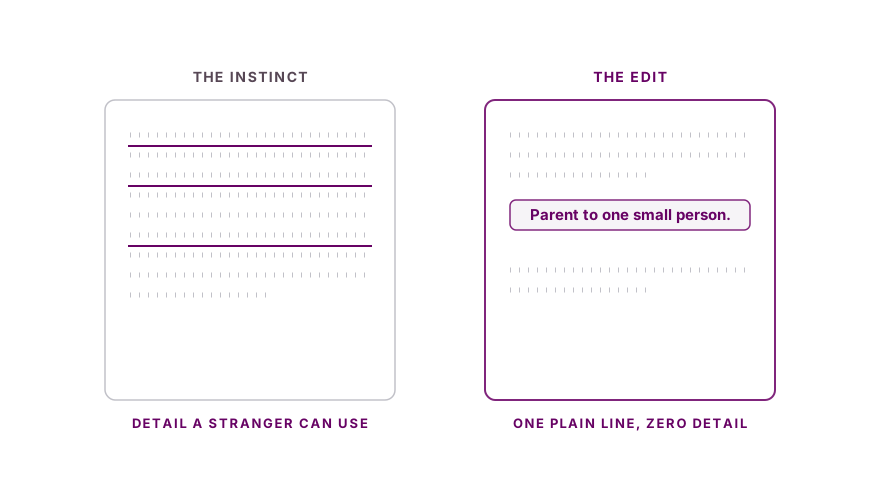
Yes, say that you have a child, and then give no detail about that child at all. Two separate decisions get treated as one. The first is whether to say you have a child at all. Say it. It is the cheapest filter available, and it happens before anyone has your time.
The second decision is how much detail to give, and the answer is: none. A name, an age, a school, a neighbourhood, a nursery pickup time — each one is harmless alone and identifying in combination. A profile is a public page indexed by the app and visible to accounts you cannot check.
There is a real reservation on the other side, and it is worth knowing its actual size. In a Pew Research Center survey of single adults looking for a relationship, fielded in 2019, 36% said they probably or definitely would not consider a relationship with someone who is raising children from another relationship. The survey does not say who those daters were or what they were weighing, and it does not measure the reverse. The rest of the numbers we use, with their publishers and years, sit on our statistics page.
What follows from that is not “hide it”. It is: put the fact where it does its work — early, once, without an explanation attached.
What example lines actually work?
The lines that work state the fact once, without apology, and then spend the rest of the space on something specific about you. These are patterns, not scripts. Take the shape and put your own specifics in it. None of them name a child, an age, a school or a place, and none of them apologise.
- “I have a kid, so my week is planned rather than spontaneous. It works, it’s just planned.”
- “Parent. Weeknights are usually out, weekends are more open, and I’d rather say that upfront than cancel on you twice.”
- “There’s a small person in my life who takes priority. Everything else about me: cycling, terrible at chess, will argue about films.”
- “I’m a parent and I’m not looking for a co-parent — just someone I like spending evenings with.”
- “Yes, I have a child. No, that isn’t the whole personality. Ask me about the garden instead.”
- “Single mom. I plan dates about a week out and I show up when I say I will.”
- “I have a kid and a job I like, which means my free time is limited and I use it deliberately.”
- “Parent here. If you want to know how that works day to day, ask me — it’s a conversation, not a bio.”
One shape to avoid. The pre-emptive apology is the line that concedes an objection before anyone has raised it, for example “I know a lot of people won’t want to date someone with kids, but…”. It invites a reader to agree with the first half of the sentence.
Two more things that read badly in a bio: lists of requirements addressed to the reader (“don’t message me if…”), and a defence of your situation. Neither adds information about you, and both are answered by silence from the people you actually wanted to hear from.
What should you keep off the profile entirely?
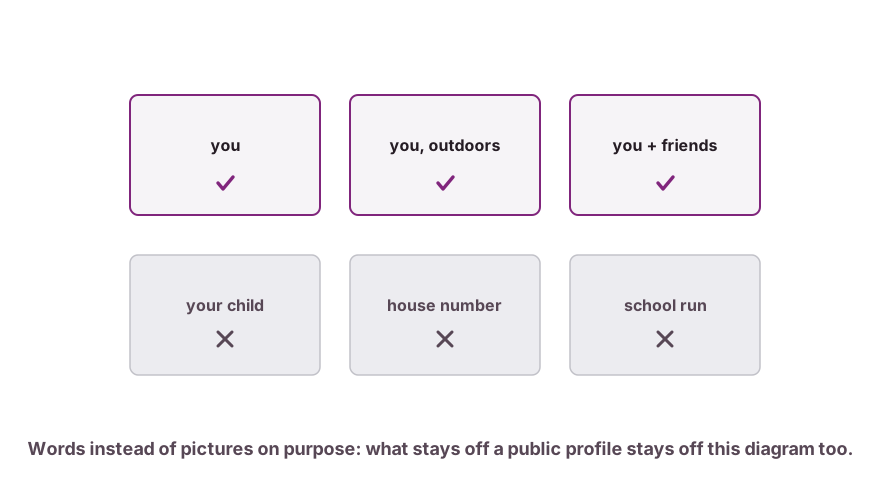
Keep off anything that could place a child somewhere: photos, a name, an exact age, a school, a neighbourhood, a workplace with a shift attached, and the custody schedule. This block is the reason the page exists. It is not a matter of taste and not a matter of comfort level: these items create a route from a public profile to a real child.
What we don't put on a profile
Not 'up to you' — these are the ones that expose a child rather than embarrass an adult.
- Photos of your child
- Including cropped, blurred, from behind, or a hand in the frame. Faces are not the only identifying thing in a picture: uniforms, house numbers and street signs all sit in the background.
- Your child's name or exact age
- A first name plus a town plus a school run narrows a family down fast. Say 'a child' or 'a kid' and leave the arithmetic out.
- School, nursery, club or team
- Any named place a child attends on a schedule. This includes photos taken at the entrance of one.
- Your neighbourhood, street or building
- Apps already publish an approximate distance. Adding the specific area on top of it removes the approximation.
- The custody schedule
- 'Kid-free every other weekend' tells a stranger which nights a child is not with you, and which nights someone else's routine is predictable. Say you plan ahead instead.
- Photos with location data still attached
- Some phones write coordinates into the file. Turn location off for the camera, or send the picture through an app that strips it, before it becomes a profile photo.
- Your workplace by name plus your shift
- The same combination problem: a named place and a repeating time.
What goes on instead
- The fact, once
- One line that you are a parent. It filters early and costs you nothing.
- How you plan
- 'A few days ahead' is useful and identifies nobody.
- Specifics about you
- What you read, cook, watch, walk to. These are what people reply to.
Location data is the set of coordinates some phones write into a photo file at the moment the picture is taken, and it travels with the file unless something strips it out. It is the item on that list people miss, because nothing about the picture looks revealing.
If a piece of information would let someone stand in the right place at the right time, it does not go on a profile. That is the whole test, and it holds even when the person asking seems fine.
The same logic governs a much later decision — when, and in what order, anyone actually meets your child. That is a separate stage with its own rules, and it is covered in introducing your child to someone you’re dating.
What photos should you use instead?
Use recent pictures of yourself alone, doing something a stranger could ask a question about. Photo slots on an app are limited, and a lot of a parent’s camera roll has a child in it, which leaves less to choose from. That is a real problem with a dull solution: take new photos.
- You, alone, doing something identifiable. Not a portrait against a wall. Something a person can ask a question about.
- A full-length picture, recent. It saves an awkward moment later.
- A picture where you are looking at the camera. One is enough.
- A photo of a thing you made, went to, or care about. It carries a conversation without requiring you to be in the shot.
Some photos are worth skipping even when they are the best ones you have:
- A photo where a child has been cropped out but their hand, shoe or car seat is still visible.
- A picture taken inside your home showing the layout, or the view from your window.
- A group photo where a friend’s children appear, which is someone else’s decision to make.
- Anything taken at the school gate, however good the light was.
Imagine a stranger reading the grid with no interest in dating you. Everything above hands that reader a place or a routine; nothing above tells them anything about you.
What wording quietly filters?
Wording filters when it states a fact about your week instead of setting a condition for the reader. A filter is a plain description of how your time works that lets the wrong person rule themselves out without any conversation. Filtering is not the same as warning people off.
“I plan dates a few days ahead” is a filter. Someone who wants to meet in an hour reads it and moves on, without anyone having a conversation about compatibility. “Please don’t waste my time” is not a filter; it addresses a person who is not reading and irritates the ones who are.
Three that carry information without conditions:
- Naming the rhythm: planned weeks, predictable evenings, occasional last-minute cancellations that are not about interest.
- Naming what you’re after in one clause — “something that turns into a regular thing” or “not in a rush” — instead of a category label.
- Naming one non-negotiable, if you have one, as a preference rather than a rule. “I don’t do late nights on school nights” reads as a life. “Don’t ask me out after 9pm” reads as a policy.
The ones that misfire: strength framing (“juggling it all”), which attracts admiration rather than interest; and a bio that is entirely about parenting, which answers a question nobody asked and leaves nothing to reply to.
If you’re the one reading these profiles
The other side of this page gets read too. A profile that mentions a child is doing you a favour, and the useful reply is a normal one about something else in the bio. Your own profile can do the same work in the other direction. Saying that you plan ahead, that cancellations don’t bother you, or that you have kids yourself, tells a parent reading it more than any statement about being “good with kids”. And the reservation runs both ways — the Pew figure above measures daters in general, not men and not one gender’s willingness. No survey we could verify measures that at all, which is why you will not find a percentage for it here.
Where the profile actually goes
A bio only matters on a platform where someone will see it. Apps differ enough that the same wording performs differently: some are built around parents, others are not, and the free tier is where the differences show up. Our reviews of how the apps differ are in dating apps for single parents.
For scale, one measured baseline: Pew Research Center reported in 2023 that three-in-ten U.S. adults say they have ever used a dating site or app. That figure covers all adults, married included, and Pew publishes no breakdown by parental status — so it is context, not a statement about parents.
If you are earlier than the profile stage and the question is whether to start at all, that is handled separately in when to start dating again, which deliberately contains no number of months. The rest of the practical material — time, logistics, what you tell people and when — sits in the dating as a single mom hub.
The short version
Say you’re a parent. Say it once. Give no detail that could locate a child, including the photograph you were hoping was fine because the face is turned away. Fill the remaining space with things about you that a stranger can ask a question about, and describe your week honestly enough that anyone it would not have suited can see that for themselves.