
When should a single mom start dating? Every version of that question expects a number back, and there isn’t one. The numbers that circulate — a fixed count of months, “wait until they’re in school” — trace back to magazine polls and dating-app press releases, not to anything you could check.
When should a single mom start dating is a scheduling question wearing the clothes of a timing question: it asks what has to be true in your week, not how much of the calendar has gone past. So this page answers the version that actually has an answer — what has to hold for dating to work at all, and which single decision does have a correct order. The rest of the hub, dating as a single mom, covers the day-to-day around it.
Why does the “right time” question have no number?
The question has no number because nothing trustworthy has ever measured it. Two things get confused here. The first is what people did, which occasionally gets surveyed. The second is what suits your household, which never does. An average of the first tells you nothing about the second, even when the survey is well run — and the timing survey most often quoted at single parents turned out to be a brand poll with no published method. We list what we could and couldn’t verify on our statistics page, including the timing figures we rejected.
A timing norm is a published figure claiming to say how long a parent should wait before dating again. This site carries none, because none of the circulating versions survived a look at how it was produced.
The scale of the question is measurable even when the answer isn’t. The U.S. Census Bureau counted 9.8 million one-parent households in the United States in 2023 — households, not people, and nothing in that count describes who is dating or when they started.
What actually moves the timing is specific to you: how old your child is, how predictable the week is, whether anyone else can take an evening, and how much capacity you have left after the parts that can’t be moved. Consider two mothers whose children are the same age: they can land in very different places on this, and both be right.
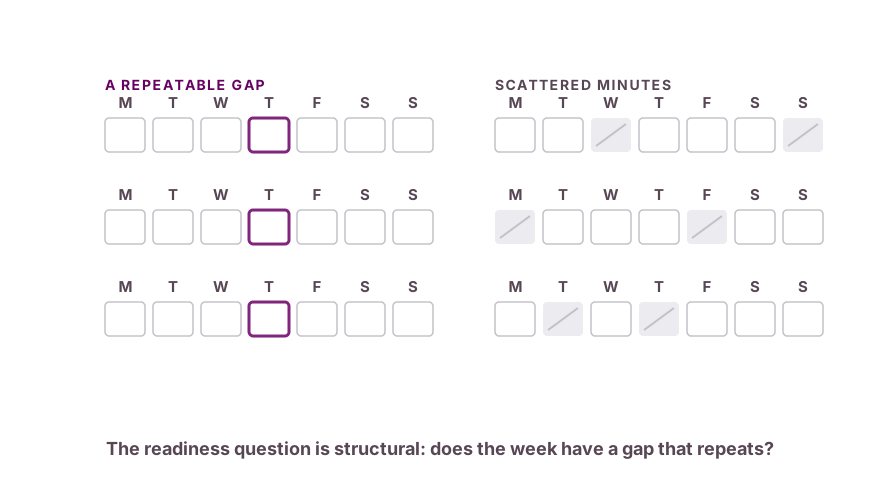
What are the signs that dating is workable now?
The signs are practical rather than emotional. If they hold, the calendar question is already settled.
- A repeatable window is a specific evening or afternoon that exists most weeks — not “whenever things calm down”, which is not a slot.
- Childcare is arranged, not improvised. A named person who has agreed in advance. If the plan needs someone to say yes at the last minute, it isn’t a plan.
- You can cancel without it costing your child anything. Cancellations are normal here. They become a problem when the child was moved around to make the evening happen.
- You can leave your child out of the conversation. Not secrecy — just that the first stage is yours. If describing your life turns into describing your child’s, that’s a sign to slow down, and it’s also what your dating profile should reflect.
- You want the evening, not the relief. Wanting company is a reason. Expecting a new person to reduce the load is a plan that fails on both sides.
- You’ve decided what you’re doing about apps or introductions from friends. Deciding the route is part of starting; drifting into it is how people end up messaging late at night and concluding they aren’t ready.
Imagine a week whose only free evening depends on one person saying yes on the day itself. That is not a repeatable window. It is a hope with a sitter attached.
One thing that is not on this list: how the child feels about it. At this stage your child doesn’t know, and shouldn’t have to.
If you’re the one dating her
The same page reads differently from your side, so: none of the above is a test she’s putting you through. A repeatable window means plans get made further out and cancelled at short notice, and the cancellation is rarely about you. The signs on your side are the mirror ones. Can you hold a plan made well in advance, and take a cancelled evening without making it cost her anything? And are you comfortable being nobody’s parent for a long time?
What changes the answer more than time passing?
Three things change it more than time passing does: the age of your child, how predictable your week is, and whether anyone else is in the arrangement at all. Time passing is the weakest variable here, and all three of these are logistical rather than emotional.
The age of your child. With a toddler, the constraint is bedtime and the fact that evenings are the only window and also the most tiring one. With a school-age child, the constraint is the after-school block and how far your help lives. With a teenager, the schedule loosens and the privacy tightens: nobody needs a sitter, but a phone left face-down gets noticed.
Whether the week is predictable. A rota that changes month to month is harder to date around than a demanding but fixed one. Predictability beats free hours.
Whether anyone else is in the arrangement at all. A second household that takes alternate weekends produces a different calendar from no second household. That’s a scheduling fact, and it’s the one worth being blunt about with anyone new — not the history behind it.
What is the one thing that does have a correct order?
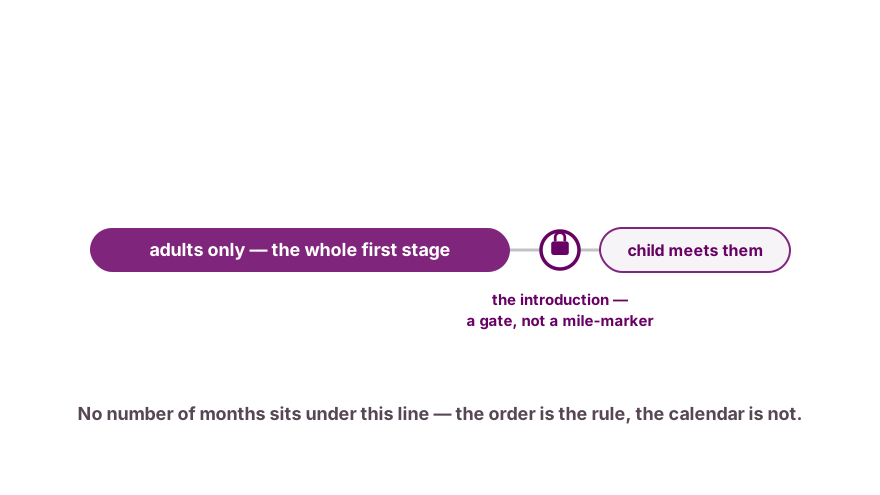
The order is: the relationship becomes stable first, and your child meets the person after. Never the reverse, and never as a way to find out whether the relationship is serious.
An introduction is not a test. It is something you do once you already know the answer, because the person who carries the cost of a wrong answer is the one who didn’t get a vote. Sleepovers are a separate decision again, and a later one. All of that has its own page: introducing your kids.
The best-known numbers on introduction timing come from dating platforms with a product to sell. We don’t publish them, because a number in that position functions as permission.
How do you start when you have no help at all?
You start in daylight, in short meetings, and with fewer of them. No co-parent taking weekends, no grandparent nearby, no standing sitter: this is the version the advice usually skips, and it changes the shape of starting rather than ruling it out.
A daytime date is a first meeting placed inside school or nursery hours, and it costs nothing in childcare. A coffee or a weekday lunch, for example, is a real first meeting. Evenings are the expensive slot; spend them later, when the person has earned the sitter.
Keep the first meeting short and public. The length of a coffee, in a place you’d go anyway. Not your home, not near your child’s school or nursery, not while your child is with you. That last part isn’t etiquette — a stranger who knows where your child is in the day is a risk you can’t take back.
Assume fewer dates, not shorter ones. Without help, the limiting resource is arrangements, not interest. A couple of good meetings beats a handful you had to engineer.
Notice what the arranging costs you. If setting up one evening takes more out of you than the evening gives back, that’s information about the week, not about you. Where that becomes a steady state rather than a bad month, guilt and running on empty covers what that looks like and where an article stops being the right help.
Online is where a lot of this starts, and the numbers there are broader than people assume: Pew Research Center reported in 2023 that three-in-ten U.S. adults say they have ever used a dating site or app. That base is all adults, married ones included, and Pew publishes no breakdown by parental status — so nobody can tell you how many single parents are on apps right now, including us.
What this page deliberately doesn’t say
It doesn’t name a number of months, or a birthday to wait for. If a source gave us a defensible figure we’d print it with the publisher’s name attached, and if one turns up we’ll add it. Until then, the honest answer to when a single mom should start dating is that the week decides it, not the calendar.
Checked August 20, 2026.