A free single mom dating site is one you can install, fill in and browse without a card on file — a smaller promise than the phrase sounds, because replying is usually the paid step. That is why the search is not really about the download. It is about whether you can actually talk to someone without paying, and on the apps covered here, browsing is free while replying is the product. This page says which action each app holds back, rather than handing you a list of five apps and calling them free.
What does “free” usually mean on these apps?
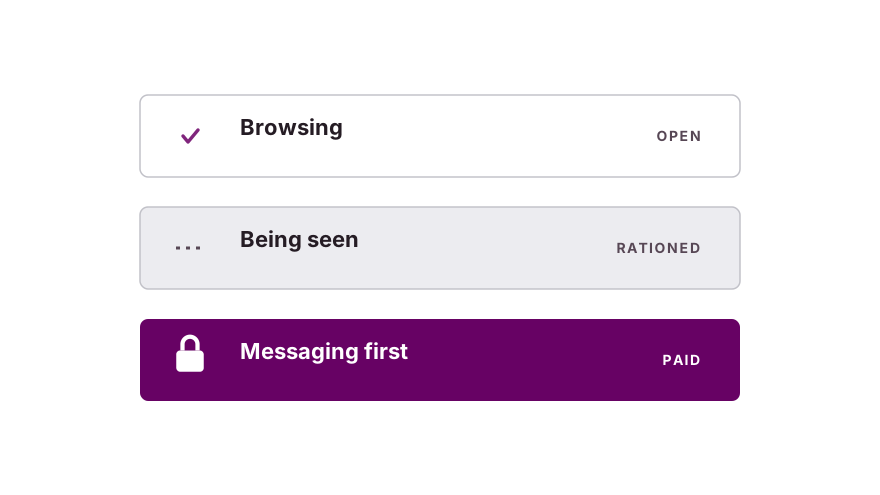
It means free to look, usually free to be seen, and almost never free to speak. Split “free” into those three separate permissions and the category stops being confusing.
Free to look. Installing, building a profile and scrolling through other people costs nothing on every app in the table below. This is the part every app advertises, and it is genuinely free.
Free to be seen. Also usually free, but rationed. Your profile is shown to fewer people, or shown later, than a paying account’s. Nothing is blocked; the dial is just turned down.
Free to speak. This is the paid one. On the apps built for parents in the table below and on the mainstream apps they compete with, the wall arrives at the moment interest becomes a conversation — sending the first message, or seeing who already liked you.
That order is not an accident, and it is the part worth naming. A free tier is designed to accumulate unanswered interest and then sell you the key to it. The app is at its most persuasive at the exact moment you are most frustrated, which is why the upgrade prompt appears there rather than at sign-up. Knowing the mechanism in advance is not cynicism. It is reading the business model before it reads you.
What does each app block?
Nearly all of them block the same two things: the first message on a match, and the list of people who have already liked you. A paywall is the point in a product where a specific action stops working until you subscribe, and in this category it sits at the reply.
Affiliate disclosure, above the table rather than in the footer: some links in this section of the site can earn us a commission. No app appears here because of that, and nothing was moved up or down for it. We also have not registered with payment details anywhere, so this table contains no prices and no numeric limits. Where we have not verified something, the cell says so instead of borrowing a figure from another review site.
| App | Free without paying | Where the wall usually falls | Not verified by us |
|---|---|---|---|
| Stir | Install, profile, browsing | Messaging and the visibility extras | Price, exact free-tier limits |
| SingleParentMeet | Install, profile, browsing | Messaging | Price, exact free-tier limits |
| Mainstream swipe apps | Install, profile, swiping, matching | Volume, likes-you lists, boosts | Per-region limits, which are A/B tested |
| Facebook Dating | Everything the product does | Nothing is charged for | Whether the data trade suits you |
| Older "free to message" sites | Messaging, historically | Filters, visibility, read receipts | Whether that still holds today |
Two things follow from the table. First, the apps built specifically for single parents are not the free ones — Stir and SingleParentMeet both sell the reply, and both are worth judging on how many people near you use them rather than on their free tier. Second, the limits inside these products are tested and vary by region and account age, so someone else’s screenshot of what they got for free is not evidence about your account.
How do you judge a free app’s safety without a ranking?
You check four things yourself, because “which of these is least scammy” does not have a league-table answer. In the order that matters:
- Who owns it, and is that stated? An operator with a name and a company behind it can be complained to. An app with no owner listed anywhere cannot.
- Is it in the official app stores? Store distribution is not a safety guarantee. But a service that routes you to a direct download, for example, has a reason for avoiding the stores.
- What does it ask for before you have used it? A request for an ID scan, a phone contact list or bank details at sign-up is a much bigger cost than a subscription.
- How do you leave? Find the account-deletion page before you fill the profile in. If deletion means emailing support and hoping, treat everything you upload as permanent.
Free products are not automatically riskier than paid ones, and paying does not screen anyone in. What paying does is create a paper trail, which is a small thing but not nothing.
There is a check that beats any list, this one included. Install the app, build the profile, and try the single action you actually need. Consider the two most common ones: send a first message on a match, or open the list of people who have already liked you. Whatever the app stops you doing is its paywall, today, on your account, in your country. That is the only pricing research that is genuinely current.
Which apps are genuinely free, and what is the catch?
Facebook Dating is the closest thing to “100% free” among widely used apps, and the catch is that you pay in account data rather than money. There is no subscription, no paid message upgrade and nothing to boost. The catch is structural rather than hidden: it lives inside a Facebook account, uses the profile and photo material already sitting there, and is funded the way the rest of Facebook is funded.
For a parent that structure carries one specific hazard worth stating plainly. Photos already on a personal account can easily include a child, and the fastest way to end up with your child’s face on a dating profile is to reuse an album that was never meant for strangers. Choose each photo deliberately, one at a time. No child in the frame, no school uniform, no house number, no location tags. The rules for what belongs on a parent’s profile are the same everywhere, and they are set out in our guide to writing a dating profile as a parent.
Staying on a free account of a paid app is the other genuinely free route, and it comes with one condition. On a free tier your leverage is being the person who gets messaged, not the person who messages. That makes the whole thing a writing problem rather than a payment problem. Three things carry it: a first photo that reads as a real face, a profile line that says you are a parent without describing your child, and something specific enough to reply to. Free accounts fail hardest for people who want to initiate.
Groups and community routes cost nothing at all — settings such as local single-parent meet-ups, evening classes, faith communities and volunteering rotas. No profile to write, no algorithm, and no verification either, so first meetings happen in public and nobody meets your child for a long time.
Some context on how many people are on any of this. Pew Research Center, in a survey of U.S. adults fielded in July 2022, found that three-in-ten U.S. adults say they have ever used a dating site or app — that covers all adults, married ones included, and measures “ever used” rather than current use. The same Pew survey found that 52% of U.S. adults who have never been married have used an online dating site or app, compared with 16% of married adults. Neither figure is broken out by whether the respondent is a parent, because no such breakdown exists in the source. Both, with their publisher, year and links, sit on our statistics page.
If you only pay for one thing, what should it be?
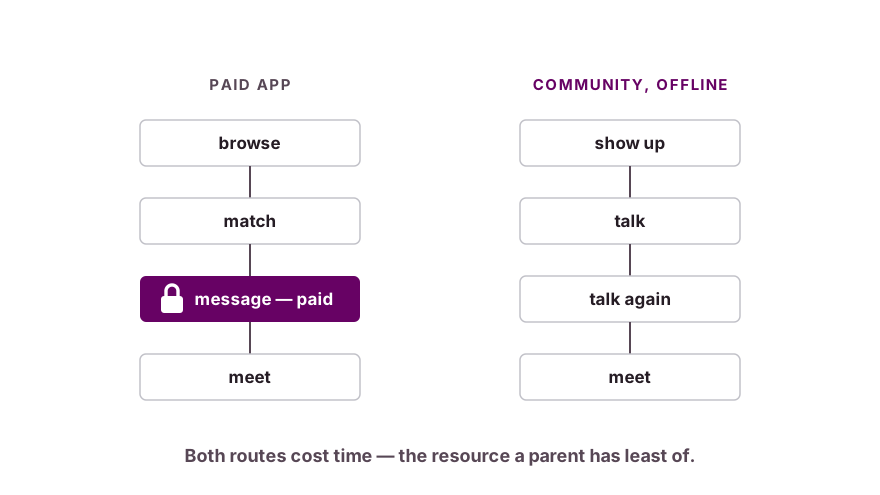
Pay to reply, on one app, once you already have unanswered interest sitting there. That is the purchase with a visible return: you can see exactly what it releases before you buy it. If a subscription is going to happen, buy the thing that removes a block, not the thing that promises attention.
A boost is a paid promotion that shows your profile to more people for a limited window. Pay for that, or for any other visibility feature, and you are buying a probability described by the company selling it.
Four habits that save more than any tier does:
- Buy at the shortest term first. The multi-month bundle is discounted because it is sold at the moment of most frustration, and that is not the moment to commit a quarter.
- Find the cancellation path before you pay. It lives in your app-store subscriptions, not inside the dating app. If you cannot find it, you are not ready to subscribe.
- One app at a time. Two subscriptions do not double the pool. They double the admin, on evenings that are already spoken for.
- Fix the profile before paying to amplify it. Paying to show more people a profile that does not work simply distributes the same result more widely.
The comparison of what each parent-focused app actually offers, and who each one suits, is on the dating apps for single parents hub.
What we don't do on this page
Pages about free dating sites are the easiest place in this category to be quietly dishonest, so here is what is deliberately absent.
- We don't publish a "top 5 free apps" list
- A ranked list of free apps has an incentive problem: the order can be sold, and the apps padding it may block the only action you wanted. Naming the blocked action is more useful than naming five apps.
- We don't print prices we haven't paid
- Verifying a subscription means a real registration with real card details. Until that happens the price stays out rather than being copied from an aggregator that copied it from somewhere else.
- We don't call anything free without saying what is free
- Free to install, free to be seen and free to reply are three different products. Any page using the single word without splitting it is selling something.
- We don't quantify free-tier limits
- Swipe counts and message caps are A/B tested by region and account age. A specific number would look authoritative without being accurate for a given account.
What is actually checked here
- The pattern, not the price tag
- Which action sits behind the wall on each type of app, described as product design, with a check you can run on your own account.
- The date
- Everything on this page carries the date it was checked: 20 August 2026. If it stops being re-checked, the date will say so.
- The numbers
- The only figures here come from Pew Research Center, named in the same sentence as the publisher and the survey year, and repeated with sources on our statistics page.
What does not change, free or paid?
One rule holds on the free routes and the paid ones equally, and it is the reason the cheapest option is never automatically the right one: nothing about your child goes on a public profile. No photograph, no name, no school, no neighbourhood, no custody schedule written out in a bio. A free app that asks for more personal detail than a paid one is not a bargain.
The other free thing worth more than a subscription is patience with the first meeting. Public place, your own transport, a friend who knows where you are. That costs nothing on every app in this article.
Where to go next
- The full shortlist and how the parent-focused apps differ: dating apps for single parents.
- The Match Group app most people compare first: Stir, reviewed.
- The older service with the similar name: SingleParentMeet, reviewed independently.
- What to write, and what to keep off a profile entirely: writing a dating profile as a parent.