
What does single parent christian dating usually mean?
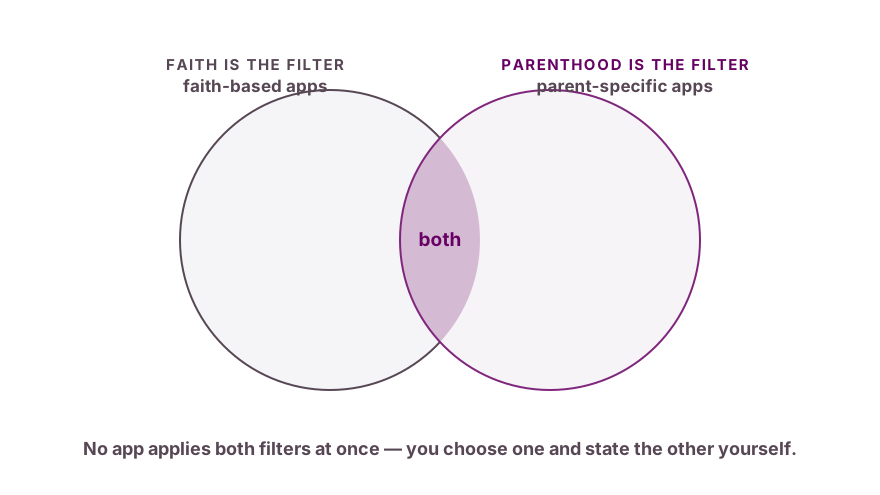
Single parent christian dating means one of two routes in practice: a faith-based app, where belief is the filter and parenthood is a line you write yourself, or a church community, where the opposite is true.
It is also a search with two different problems behind it. One is practical: which app, and does it cost anything. The other is quieter and harder to type into a search box — whether the congregation you sit in on Sunday is going to be a support or an audience while you do this.
This page handles the first properly and is honest about the limits of the second. We review dating products. We are not a religious authority and will not tell you what your faith requires.
Which apps filter for faith?
Faith-based apps such as Christian Mingle and Upward do, and none of them filters for parenthood as well. A faith-based dating app is one that sorts its members by belief — denomination, church attendance, how central it is to an ordinary week — and treats everything else, parenthood included, as profile text. Apps built for single parents sort the other way round. Whichever you choose, the fact it does not sort for becomes a line you write yourself.
We have not registered with payment details on any of these services, so there are no prices on this page. The prices circulating in comparison listings for faith apps are not something we have verified, and the ones we followed traced back only to another listing. Copying one would make this page look more useful while making it less true.
Affiliate disclosure, above the table rather than in the footer: some links in this section of the site can earn us a commission. Nothing here is ordered by commission, and we have no commercial relationship with any service named below.
| App | What it filters for | Status of what we can tell you |
|---|---|---|
| Christian Mingle | Belief, denomination, church attendance | Verified: operated by Spark Networks, official app-store distribution. Price not verified. |
| Upward | Belief, in a swipe-app format | Verified: a Match Group product, so the interface and paywall pattern match its mainstream apps. Price not verified. |
| Stir | Parenthood, not belief | Verified: Match Group, built for single parents. Price not verified — see our full review. |
| General apps with a faith field | Neither, until you write it | Some mainstream apps carry a religion field; how heavily it weights matching is not published. |
| Any app's member counts | — | We found no source that is not the platform's own marketing. |
| Any app's success rate | — | Same. We publish no figure of that shape anywhere on this site. |
The choice is less agonising than it looks. If belief is the thing you will not compromise on, start with a faith app and write one clear line about your child. If the schedule is the harder problem and your church already knows you, an app built for parents does more work — that is the case we make in our review of Stir.
Density decides everything either way. A niche audience inside a niche audience is a small room in a mid-sized town, and no review can tell you how full it is where you live. Open both, look at how many profiles appear within a reachable distance, and let that decide before any feature comparison does.
What differs in practice from a general app?
Four things change, and one thing does not change at all.
Conversations start further along. Imagine the same first message on two apps: on a faith app, a shared answer about church attendance has already settled something the general app leaves you to work out over a long stretch of texting. That is the entire value proposition, and it is real.
Marriage is the stated frame. Faith apps market themselves around marriage rather than open-ended dating, and profile text tends to follow the marketing. No survey we can cite measures how often that turns into an early conversation about it. If it suits you, it saves time. If you are some way from that decision, say so early rather than being carried along by someone else’s timeline.
Your parenthood is still yours to place. Belief being pre-sorted does not mean the child is. You will still write that line, and it works the same way it works everywhere else: state the fact, skip the details. No name, no age paired with a school, no photograph, no custody schedule in a public bio. The wording that does this well is in our guide to writing a dating profile as a parent.
The pool is smaller, not kinder. A faith label filters what people say they believe. It does not filter for how someone behaves when plans change at short notice, which is the thing you actually need to know. Shared belief and good conduct are not the same variable, and an app that sorts for the first cannot check the second.
What does not change: the paywall. A paywall is the point in a product where a specific action stops working until you subscribe, and faith apps run the same commercial model as everything else — free to install and browse, paid to reply. Where the wall sits on each app is the subject of where the free tier stops being free.
One figure is worth keeping in view here. Pew Research Center, in a survey of U.S. adults fielded in July 2022, found that three-in-ten U.S. adults say they have ever used a dating site or app — all adults, married ones included, and “ever used” rather than current use. It is not broken out by parenthood or by faith; no such breakdown exists. It sits with its source on our statistics page.
Are church and community routes better?
They are better at one thing and worse at another, and the trade is worth naming before you start rather than after. For a lot of people this is the actual question anyway, and it is not really about software.
What they are better at is evidence. Meeting someone through a congregation, a small group or a volunteering rota has one structural advantage over any app: you see a person over time, in circumstances they did not design. A small group is a regular midweek gathering of a handful of people from the same congregation, and it is the kind of setting where somebody is watched over months rather than described in a bio. How someone treats the person setting out chairs tells you more than a profile ever will.
For scale on the other route: Pew Research Center, in that same July 2022 survey, found that one-in-ten partnered adults met their current significant other through a dating site or app. The base includes relationships formed long before apps existed, so it is not a success rate and says nothing about parents specifically. Apps are one route among several, not the route.
It has an equally structural cost, and it is worth naming before you start rather than after. The people are still there afterwards. If it ends badly, it ends inside the room you both attend on Sunday, and one of you may quietly stop coming. Apps have the opposite shape: no history before, no shared room afterwards.
Two practical notes for the community route.
Decide in advance what you are willing to have known, because a congregation is a network and information moves through it. Consider the small facts first: that you have started dating at all, who it is, and whether either of you wants that discussed on a Sunday morning. That is not a warning about anyone’s character; it is how any close community works.
And keep the child-safety line exactly where it is. A church setting can make an early introduction feel harmless — the person is known, other children are present, nothing seems risky. The order does not change with the venue: the relationship becomes stable first, the introduction is a separate and later step, and it is never a way to test whether the relationship works.
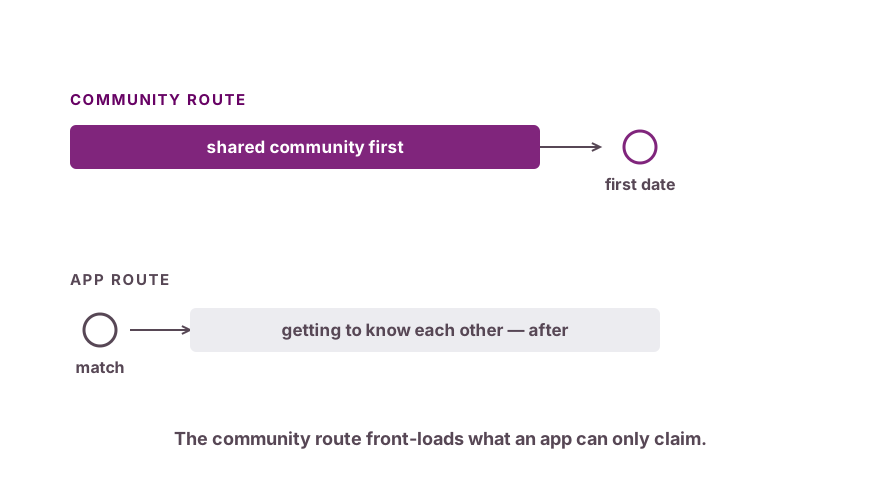
If your congregation runs a group for single parents, that is a better starting point than any app, for a reason that has nothing to do with romance: it is the one setting where nobody needs the schedule explained.
What we don't do on this page
A faith-adjacent page is an easy place to overreach. Here is where we stop on purpose.
- We don't issue theological verdicts
- We describe how passages are commonly read and point you to your own congregation. A dating review site handing down doctrine is a site inventing authority it does not have.
- We don't judge anyone's household
- Not readers, not the people they date, not their past. Nothing on this site weighs whether a person is worth the trouble.
- We don't print prices we haven't paid
- Verifying a subscription means a real registration with real card details. Until then the price column stays empty rather than copied from a comparison listing.
- We don't treat faith branding as a safety feature
- A stated belief is not a background check. The safety habits are identical to any other app: meet in public, tell someone where you are, and keep your child out of it entirely at this stage.
What is actually checked here
- Who runs what
- Christian Mingle is operated by Spark Networks; Upward and Stir are Match Group products. Ownership explains the interface and the paywall more than any feature list does.
- Dates
- Everything on this page carries the date it was checked: 20 August 2026. If it stops being re-checked, the date will say so.
- Numbers
- The two figures here come from Pew Research Center and are named in the same sentence as the publisher and the survey field date.
Where should you start?
Start with whichever app is not empty where you live, and let one evening decide it rather than a feature comparison. Three steps, in order:
- Open a faith-based app and a parent-focused app on the same evening.
- Look at how many real profiles each one shows within a distance you would actually drive.
- Write the same clear line about being a parent in both, and keep the one that is not empty.
Then read the rest of our dating apps for single parents section before paying for anything, because the free tier tells you what you need to know first.